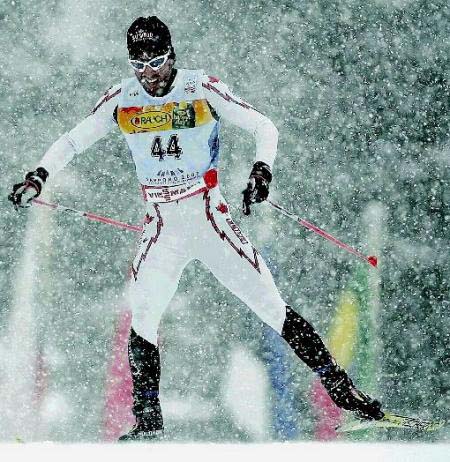
Brian McKeever
photo : Lee Jin-Man
Un exploit de Brian McKeever
 1er mars 2007
Un exploit de Brian McKeever
SAPPORO, Japon - Le Canadien Brian McKeever, un médaillé d'or des Jeux paralympiques légalement aveugle, a terminé au 24e rang du 15 kilomètres style libre de ski de fond disputé mercredi à sa toute première participation aux championnats du monde de ski nordique, à Sapporo.
Le Norvégien Lars Berger, un spécialiste du biathlon, lui, s'est imposé en 35 minutes 50 secondes, avec 35,8 secondes d'avance sur le Biélorusse Leanid Karneyenka. L'Allemand Tobias Angerer, leader du classement de la Coupe du monde de ski de fond, a terminé troisième, à 52,4 secondes.
McKeever, un médaillé d'or paralympique qui vient de Calgary, souffre de la maladie de Stargardt, une dépression de la rétine. Il n'a pas de vision centrale et seulement un peu de vision périphérique.
"C'est un très grand exploit, a commenté Al Maddox, directeur exécutif de Ski de fond Canada. Dominer l'équipe nationale et terminer parmi les 25 premiers aux championnats du monde démontre quel incroyable athlète il est."
L'objectif de McKeever est de devenir le premier athlète à participer aux Jeux d'hiver olympiques et paralympiques à Vancouver en 2010.
 1er mars 2007
Gary Kingston
VANCOUVER - You've heard of dual-sport athletes. In 2010, on the snow-covered trails of the Callaghan Valley, Brian McKeever wants to be a rare dual Games athlete, as in Olympic and Paralympic.
The legally blind skier from Canmore, Alta., took another step toward making that a reality by cracking the top 25 yesterday in the 15-kilometre freestyle race during the FIS world cross-country championships at Sapporo, Japan.
In a field of 119 starters, he beat, among others, the current Norwegian champion and a Russian who won a bronze medal during a World Cup race earlier this season in Italy. He was also 39 places better than the next best Canadian.
In typically modest fashion, McKeever, 27, said conditions played a role as it began snowing heavily 30 minutes after the start of the race, which meant "top guys who started (in the middle of the field) were pretty much screwed."
Still, McKeever, who started No. 44, was staying with some of those late starters on the second of the two 7.5-kilometre laps. His time of 38 minutes 3.7 seconds was a little less than three minutes behind the winner, Lars Berger of Norway.
"I'm very happy with it," McKeever said in a telephone interview from Japan. "It's kind of funny. At times like this, you can struggle with coming to terms with a result. Is it conditions? Did I ski well enough to finish where I did? In the end, you can't question it, the result is what it is."
By finishing in the top 25, McKeever met the FIS eligibility standard for World Cup races next season.
He began losing his sight a decade ago as a result of Stargardt's disease, a form of macular degeneration that affects central vision. He has only about 10 per cent of normal vision and once described the condition as being like the fuzzy spot a sighted person would see after staring at the sun for a few seconds, then turning away.
In disabled skiing -- he has won seven medals, including four gold, in the past two Paralympic Winter Games -- he can use a guide. When skiing against sighted competitors, he does a careful pre-race inspection to commit the track to memory. Still, there are still challenges in flat light and on downhill sections.
"The first lap (yesterday) was brutal. It was really flat light and some of the downhills were really icy, and it was rutted and chunked up. I couldn't find the smooth line and my skis were flopping all over the place. I'm sure I lost time. On the second lap, for the most part, I was following people and it was easier to pick out lines."
McKeever placed 39th in Saturday's 30-kilometre pursuit. His favorite event, the 50 kilometres, is scheduled for Sunday, and his goal is top 20.
"I'm going into it pretty confident, not just from today, but especially from the 30K," he said. "I skied in a group there for a couple of laps where the pace was very fast, but I skied comfortably with them."
McKeever's goal is to become the first winter sport Paralympian to compete during the Olympics. It's believed only one summer Paralympian, 1,500-metre runner Marla Runyan of the United States, has competed in an Olympics.

page mise en ligne par SVP

Consultez
notre ENCYCLOPÉDIE sportive